SPC / WPC / LVT Flooring Differences
Many customers are confused about the differences between SPC, WPC, and LVT flooring.
SPC (Stone Plastic Composite), WPC (Wood Plastic Composite), and LVT (Luxury Vinyl Tile) are three widely used flooring options, each with unique characteristics. Understanding their differences is key to choosing the right flooring for your specific needs.
1. Composition
SPC Flooring Core layer: Approximately 75% calcium carbonate powder mixed with 25% PVC resin, forming a rigid and dense base. Additional layers include an embossed wear-resistant layer, a printed decor layer (simulating wood, stone, or tile textures), and a UV-resistant coating.
WPC Flooring Core layer: Composed of PVC, foaming agent, calcium carbonate, and wood-like materials (such as wood flour or wood particles). Its structure consists of a bottom stability layer, the core layer, a printed decor layer, and a top wear-resistant layer—delivering a natural wood-like appearance and feel.
LVT Flooring Made of multi-layer flexible PVC vinyl with a flexible core. The layers include a UV-protective topcoat, a wear layer, a printed decor layer, and a backing layer; some models also add a fiberglass layer to enhance dimensional stability and prevent curling or gapping.
2. Performance
Durability
- SPC: Due to its rigid core, it has high durability—effectively resisting heavy foot traffic, impacts, and dents.
- WPC: Highly durable, but less impact-resistant than SPC; its wood components make it more prone to denting. Suitable for areas with moderate foot traffic.
- LVT: Durable, yet its flexible core makes it more susceptible to indentation than SPC, leading to faster wear in high-traffic areas.

Stability
- SPC: Has excellent dimensional stability—resistant to temperature and humidity changes, avoiding expansion, contraction, warping, or buckling.
- WPC: Stability is moderate; wood components make it sensitive to humidity, causing slight expansion in high-humidity environments and minor contraction in dry conditions.
- LVT: Stability is fair; more likely to expand or contract with temperature fluctuations than SPC, which may lead to gaps or overlapping over time.
Moisture Resistance
- SPC: Is 100% waterproof when installed correctly—its rigid core and sealed edges block water penetration, making it ideal for moisture-prone areas.
- WPC: Is highly moisture-resistant, thanks to its PVC core. However, long-term exposure to standing water may cause its wood components to absorb moisture, leading to potential damage.
- LVT: Is water-resistant but not completely waterproof; water seeping through seams or edges can damage the underlying layers.
Comfort Underfoot
- SPC: Has a relatively hard feel due to its rigid core; pairing it with underlayment can improve comfort.
- WPC: Offers a natural wood-like feel; the foaming agent in its core adds flexibility, making it more comfortable than SPC.
- LVT: Its flexible vinyl core provides a soft, cushioned feel—perfect for barefoot use.
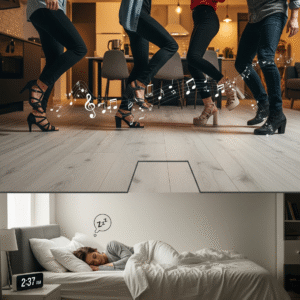
Sound Insulation
- SPC: Has limited sound insulation; its hard surface easily transmits sound, but adding underlay can significantly improve this.
- WPC: Has moderate sound insulation; wood components and its structure help absorb sound, making it quieter than SPC.
- LVT: Has better sound insulation than SPC; its flexibility effectively dampens sound vibrations.
3. Installation
SPC Flooring Uses a click-lock system—no glue or nails required, making it DIY-friendly. The rigid planks can mask minor subfloor imperfections, and installation is quick and simple.
WPC Flooring Can be installed via a click-lock system or with an adhesive. Due to the weight and flexibility of WPC planks, handling them takes more effort than SPC, especially for large-scale projects.
LVT Flooring Supports multiple installation methods: some use a DIY-friendly click-lock system, while others require an adhesive. Its flexible planks conform better to uneven subfloors than SPC.

Conclusion
Ultimately, the choice among SPC, WPC, and LVT flooring depends on your specific needs and priorities.
If you require high durability and excellent stability, especially in wet or high-traffic areas, SPC is undoubtedly the best choice. If you are looking for a more comfortable feel underfoot and better sound insulation, then WPC or LVT may be a better fit for you.
We hope this guide has helped you gain a clearer understanding of these flooring options, enabling you to make a well-informed decision.